Friday, August 31, 2012
Two weeks in Romania - Summer 2012
 Madrid is a ghost town during the month of August and closely resembles a city in a disaster movie hit by a mysterious plague and that's because August is holiday time in Spain and everyone leaves the torrid heat of the capital and heads for the coast or the mountains. My students were no exception and were dismissing themselves one by one and going away on their holidays so I desperately needed to find something to do. I too had to escape and I wanted a busy holiday, one that would keep my mind occupied and I wanted to go somewhere I had never been before.
So I decided upon a two-week driving holiday around Romania.
But why would anyone want to go to Romania? True, the Romanians haven't had a very good press in Spain with all the gypsies here and the frequent mention of Romanians whenever crime is involved. Of course, you shouldn't generalise, or even believe all you read in the newspapers. And, well, I had always wanted to see Translyvania, and once I'd figured out how big the country was it became obvious that just tracing the myth of Dracula around the country would take up a fair amount of time. And then I had heard about the Painted Monasteries in the north which are a World Heritage Site so that was something else. And there was a touch of strangeness about the prospect of going there, the unknown, not knowing what exactly I would find and that gave it a certain appeal plus not knowing a single word of Romamian making it more of an adventure.
But first some history and geography. Romania is a relatively new country and was only recognised as an independent country at the Treaty of Berlin in 1878 after years of belonging, mostly, to the Ottoman Empire. There's three main regions to Romania (with excuses to Maramures in the north, the Banat in the west and the Danube delta and coast) - Wallacia in the south which contains Bucharest the capital, Translyvania in the middle and Moldavia in the north/east. And because of its long gestation period you will not be surprised to learn that its all a bit of a mess. Translyvania, itself, was a part of Hungary until 1918 and still seems almost German while the old Moldavia has been cut in two, the eastern part is now the independant Republic of Moldova while the west is in Romania, while inside the region of Modavia is Southern Bucovina, the northern part of which is now in Ukraine. And over on the east coast on the Black sea, the part that's referred to as the Danube delta, its really called Dobrogea, the southern part of which is in Bulgaria. Confusing, isn't it?
Anyway, to my surprise, the holiday turned out much easier than I imagined it would. I wanted two weeks full of things to catch my attention, to take my mind off my life, and that’s exactly what I got. But I did expect it to be more difficult, especially regarding communicating with the locals. But no, all the people I needed to speak to all spoke English – the hotel staff, the garage attendants, the shop people (less so), the barmaids, even the police. And because of all my pre-trip planning and printing of maps, I found my hotels fairly easily.
So what were my first impressions of Romania? The first was the heat. I had been warned that it would be hot but the humidity in Bucharest was a surprise. Next it was the strangeness, and lack of any planning, of the roads. I hadn't realised that the hotel I had booked was actually on the Bucharest Ring Road but the complexity of the hotel directions for a 3 mile journey looked complicated enough to warrant extra planning in the form of a detailed Google map.
And I´m glad I did because the inclusion on the map of a well-known hamburger joint was key to my finding my way because the Romanians clearly don't believe in adequate directions or prominent naming on the roads. So, after a couple of circuits down the Route 1 and back through the airport complex in my hired car, - curiously enough there's an underpass that allows you to turn around but not one that allows you to actually join the Ring Road - So McDonalds do had a function after all.
At the hotel I met my second Romanian of the trip and once again perfect English was used. And, of course, after a further two weeks my impressions of Romanians would be turned upside-down for they proved to be a very normal, helpful and hospitable people.

So, first the best sights of Romania;
1) Corvin Castle at Hundedora (left), in the west of Translyvania and was built in the 14th century, is a real medieval wonder, although getting there meant a round trip detour of about 150 Km on a very busy road crammed full of lorries but was well worth the effort. Like many things in Translyvania Its Hungarian and has been restored recently but has so many nooks and cranies that it's a delight and you get to walk along the ramparts to admire the view down on the peasants. The Rough Guide says there's a steel plant in front of the castle but to my eyes its miles away on the outskirts of town. Anyway, the picture above is the view you get as you enter the grounds and although its the same view the picture really doesn’t do it justice, it really is an awesome sight if you like castles and even the famous Patrick Leigh Fermor said in the 1930's that "its looks totally unreal".

2) Sibiu, also in Translyvania has been improved since the EU named it as the Capital of Culture in 2007 and the three lively interconnected squares in the centre were complete with a Rock concert in the main square on the evening I arrived. This is the second biggest square, Piata Mica, and this is the view from the terrace of my favorite bar. The spire on the right is the currently-being restored, and therefore closed, Evangelical Cathedral (how annoying; Dracula's son - Mihnea the Bad - is buried there ) and the one on the left is, I think, the Catholic Church, but don't quote me.
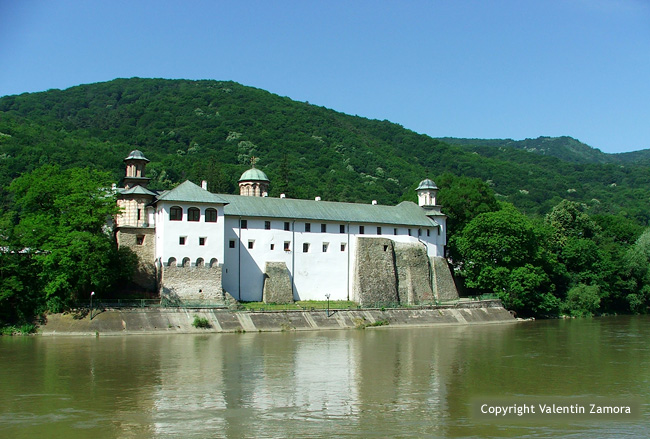
A virtual tour is here: : http://www.360concept.ro/panorame/calimanesti-caciulata/manastirea_cozia/
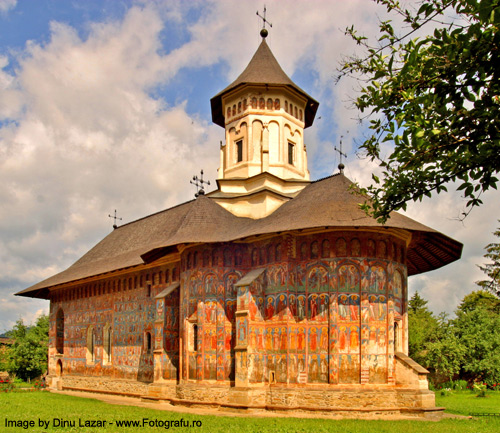
4) I managed to see the five main Painted Churches in Southern Bucovina, Moravia complete with 500 year old frescos on the outside as well as the inside; there are two or three more but I ran out of time. This one on the left is at Sucevita. They all date from the 16th century and because of the large overhanging eves the exterior walls have been protected from the elements, although there's usually at least one wall that has suffered more than the others. The most impressive ones take up the entire wall and tell stories from the bible. The Last Judgement is featured at least three times and shows a red torrent of fire or blood leading down to hell and the one at Voronet is the most striking. The saints and devils are variously playing their part to get the Judged into either heaven or hell. And at Humor one of these scenes includes a scarlet woman as the Devil - as a unbiased witness, clearly.
But my favorite was at Sucevita where there's a 32 spoke ladder depicting The Ladder of Virtue. On the up-side, so to speak, are the neat rows of Angels praying for their souls as they climb the ladder and on the downside are the devils trying to pull the people down through the spokes.
And inside all these churches there are more frescos with every wall covered in them. Kings, saints and numerous martyrs being decapitated by Turks and various other scenes in boxes like cartoons all telling a story. Very impressive. Strange how the paint of exterior church frescos can last 450 years but the white lines on the roads can last no more that 10.
5) Peles castle (left). Apparently, not a castle but a palace. Built by King Carol 1 at Sinaia in 1875 it's a lot more recent than many other sites. This is as close as I got after climbing for half an hour in sweltering heat. I just couldn't face another 20 minute climb and a queue to get in.

6) and of course the wonderful medieval town of Sighisoara (left), the birthplace of Vlad Tepes,supposedly, otherwise known as Vlad the Impaler or Dracula to you and me. Hard to find but well worth the effort, and with very friendly locals. And there's a church at the top of the hill but after 150ish steps I was a bit disappointed by the look of the church and asked the entrance fee with no great interest only to be drawn into a converation with the man on the door, in perfect english, on how impressive the Olympic games had been and how he especially liked the opening ceremony.
Dracula
So what of Dracula, you may ask. As you know from the above, the legend is all based on Vlad Tepes, the Impaler and Dracula was his family name, his father being Dracul which means Dragon in Romanian and Dracula simply means son of Dracul. His castle is supposed to be at Bran, near Brasov, but he only visited it once and its mainly for the tourists. Born in Sighisoara, he spent his early life in Targoviste, the place with no sign-posts, where he is said to have impaled his fathers murderers after getting them drunk. Unfortunately, his real castle at Poienari is a ruin at the top of a hill in the Fagarasan mountains with 1480 steps leading to it. Even more unfortunate, I arrived there on a Saturday and half of Romania was trying to park in the small carpark. I continued on my journey wondering if my legs would have carried me up all those steps....
The Hotels
But the hotels! I bet the hotels were really bad, I hear you say. Well, no, they were very nice. I pre-booked six hotels at strategic point around my circular trip and got all by one of them from Booking.com where you can read the comments before you decide to book and see its position on a map so you are not surprised when you get there and you can find it easily.
 Left is the idyllic hotel I booked in the north of the country in the area Southern Bucovina in the region called Moldavia. Hilde's Residence is full of friendly staff, all speaking perfect english of course, clean rooms, free internet on the landing and very modern decor. There's a very large garden, almost the size of a field, with trees, seats, and large tables to have meals outside and plenty of parking.
I also stayed at the Phoenicia Express Bucharest, Hotel Arges Pilesti, Pension Casa Cardinal Sibiu, Hotel Paradis at Cluj and the Ambient Brasov. All very good hotels and they ranged in price from 30E to 55E a night so are not expensive. A beer costs 5/6 lei (4.50 to a Euro) and coffee a bit less. A decent meal in a hotel, with beer, will set you back maybe 40 lei, around 10 euros.
And for light refreshments I found a fabulous place in Bucovina that makes a croissant made with cheese and ham already inside - how do they do that? Anyway, delicious. And there's jams in Rumania that are so full of fruit that you can just eat it straight from the jar..
The Hotels
But the hotels! I bet the hotels were really bad, I hear you say. Well, no, they were very nice. I pre-booked six hotels at strategic point around my circular trip and got all by one of them from Booking.com where you can read the comments before you decide to book and see its position on a map so you are not surprised when you get there and you can find it easily.
I also stayed at the Phoenicia Express Bucharest, Hotel Arges Pilesti, Pension Casa Cardinal Sibiu, Hotel Paradis at Cluj and the Ambient Brasov. All very good hotels and they ranged in price from 30E to 55E a night so are not expensive. A beer costs 5/6 lei (4.50 to a Euro) and coffee a bit less. A decent meal in a hotel, with beer, will set you back maybe 40 lei, around 10 euros.
And for light refreshments I found a fabulous place in Bucovina that makes a croissant made with cheese and ham already inside - how do they do that? Anyway, delicious. And there's jams in Rumania that are so full of fruit that you can just eat it straight from the jar..
The Roads!!
One cannot leave an article about Romania without mentioning in some detail the road system. Driving so much - over 3000 km in 14 days – the state of Europe's worst road system has left quite an impression on me. Endless repairs and patches have served to render them extremely uneven and exhausting to drive along. It therefore takes ages to get anywhere and with signs non-existent or confusing making mistakes can put hours on your journey.
And because most of the secondary roads are in such poor condition, nearly all the traffic uses the two-lane national network which results in long convoys of cars trying to overtake the endless streams of lorries because a dual-carriaway is nowhere to be seen. And then there’s the potholes. Keep an eye out because only the massive ones are marked with barriers that will require driving around once the oncoming traffic has passed.
 And maybe its the delays that you meet everywhere, lorries, horse and carts, potholes and bicycles, that explain the bad driving. Its a very frustrating country to drive across if you are in a hurry and the drivers are not really really affected by solid white lines, blind bends and even on-coming traffic. In fact, if you have ever wondered why exactly they shot Ceausescu, try driving around Romania for a few days and you'll soon understand why. Driving in Romania is not for old men.
And because most of the secondary roads are in such poor condition, nearly all the traffic uses the two-lane national network which results in long convoys of cars trying to overtake the endless streams of lorries because a dual-carriaway is nowhere to be seen. And then there’s the potholes. Keep an eye out because only the massive ones are marked with barriers that will require driving around once the oncoming traffic has passed.

And regarding the traffic, it’s no good thinking you can be clever and find a short-cut away from these Romanians. Secondary roads that look a likely alternative on the map are not always the case. Start worrying when the villagers stare at you as you pass, then notice that as the white line fades from sight the road will perhaps start to gradually reduce in width. When you start hitting the foliage on either side and wonder what you will do if someone comes the other way,its too late and you should prepare yourself for the inevitable. It may be sudden or it may be gradual but eventually the road will turn into a dirt track. Curse as much as you like but the only possible solution, unless you really want to find the spare tyre, is to turn around and smile back at the peasants as you return pass them.
And then there's the signposts or lack of them and the lack of any road planning because clearly in Communist civil engineering building a road from A to B does not include any provision for a turn-off to destination C en route. On my first day driving from Bucharest to Pilesti on a decent dual carriageway, I planned to stop off at Targoviste - a mayor tourist town and old capital of Wallacia of approx 92,000 inhabitants - and 30 or so km off on the right. But nothing. No apparent turnoff, no signs mentioning Targoviste, there was nothing and it was as if the place had been erased from the map. I stopped at a filling station to consult the map. Of course, I had driven past it but failed to realise that I should have taken the turnoff to the town of Galesti and then gone on to Tagoviste, which hadn't been mentioned. So, I had to turn off and use a secondary road to go back the way I had come to get there. And that was a feature of so much of the driving.
The international airport, for example, is on national road 1 from the north from mayor towns like Brasov and Ploiesti and about 7 km from Bucharest's ring road. Now you might assume that there would be a turnoff or link road joining the two roads. Wrong. There isn't one. National road 1 goes over the ring road via a flyover and goes on into Bucharest. If you really want to get to your ring road hotel you have to find the narrow lane, I won't even call it a road, opposite the McDonalds, full of dogs (the lane, not McDonalds) and having no other distinguishing features. Then after a mile or so find the only turning off to the left that people seem to be using, although it bears no name or signs, over a disused railway line and then, hey presto, the ring road.
The international airport, for example, is on national road 1 from the north from mayor towns like Brasov and Ploiesti and about 7 km from Bucharest's ring road. Now you might assume that there would be a turnoff or link road joining the two roads. Wrong. There isn't one. National road 1 goes over the ring road via a flyover and goes on into Bucharest. If you really want to get to your ring road hotel you have to find the narrow lane, I won't even call it a road, opposite the McDonalds, full of dogs (the lane, not McDonalds) and having no other distinguishing features. Then after a mile or so find the only turning off to the left that people seem to be using, although it bears no name or signs, over a disused railway line and then, hey presto, the ring road.
On Day 5, a days excusion to the medieval town of Sighisoara from Sibiu - a distance of 100km - took over 4 hours of trying to find the right road and then getting lost. And when I did finally get there there was nothing there, just a normal Romanian village. I drove up and down the village road and there were no signs to the ancient town. I known I was there, hadn't I passed a sign saying Sighisoara, but where was it? I looked about above the houses for a sign of old buildings up in the surrounding hills but could see nothing. At one end of the village was a T junction with a sign to Brasov, a major town off to the East but I didn't want to go there, but it was the only possible way out of this ordinary street. And sure enough, after several puzzling bends, there I was in the middle of the old medieval town. Why no 'Centru`signs? Who knows, I'm not Romanian.
And then driving high above the spectacular Lake Bicaz on the left left, surrounded by the mountains.
And not forgetting the best road in all Romania, up in Bucovina where you come out of the clouds and seem to fall off the mountain on a wonderful diving, twisting, falling road as I crossed even more mountains.
And the best moment of the holiday. Alone on a Saturday afternoon, at the furthest point away from home, driving along a ridge on the completely empty road - designated 2E - with the Carpathians running beside me on the left and Ukraine in the distance on the right and Led Zepellin's Kashmir playing on the radio and nobody in the world knowing where I was. Then I got a bit sentimental and realised I really was on my own and that P would have enjoyed the view just as much as me.............
Surprises
The thousands of horse and carts clogging up the roads was the first surprise I got. They are everywhere but more in the south and there appears to be a distinct peasant class that still use them. And in the villages, everyone is a market garderner and in every village that you drive through there are tables outside all the houses with fruit, vegetables and water melons for sale and the gypsies will even shout at you as you pass to encourage you, or maybe not, to stop.
Something that I noticed that I liked was that the Romanians on the radio always pronounced any English names in their exact English pronounciation with no accent and they didn’t try to Romanize it like the Spanish do. So the singer Herbie Hancock was simply Herbie Hancock spoken in perfect english.
Up until 1920 Translyvania was part of Hungary, although full of Germans, and my guide books had mentioned several times Saxon/German people living in Romania and its very striking. In Sibiu there was even a German book shop in the main square selling only German language books, the town has a Saxon mayor and even a Saxon name, Hermannstadt. And on one day of travelling south through Translvannia every village had two names on the signs - one Romanian and the other German I think.
Nobody reads newspapers in Romania. I didn't see one person, carrying or reading one in two weeks and apart from a gossip rag called "Click", I didn't see any for sale either except when I arrived back at the airport.
And lastly, I have to mention the strange profusion of "English" plated cars at Radauti, a very pleasant small town in the north, just 15km or so from the Ukrainian border. After seeing just two English cars in 10 days on my previous travels around the country, suddenly there were dozens of them all apparently owned by the locals. The bizarre sightings reached a climax when a wedding celebration passed me, all of the cars carrying ballons and sounding horns while the first car had a mock figure of a groom tied to the bonnet, on English plates, of course.
And lastly, I have to mention the strange profusion of "English" plated cars at Radauti, a very pleasant small town in the north, just 15km or so from the Ukrainian border. After seeing just two English cars in 10 days on my previous travels around the country, suddenly there were dozens of them all apparently owned by the locals. The bizarre sightings reached a climax when a wedding celebration passed me, all of the cars carrying ballons and sounding horns while the first car had a mock figure of a groom tied to the bonnet, on English plates, of course.
And a last view of the Carpathians......


